 BackBack
 About Us


Alliance of Energy Intensive Industries
Non-Energy Extractive Industries Panel
REACH consortium "flue dust from cement clinker production"
Sustainable Process Industry through Resource and Energy Efficiency

ZVC SR - (Association of Slovak Cement Producers )
Hungarian Cement Concrete & Lime Association
Heidelberg Materials Kunda AS-i
Heidelberg Materials Cement Sverige
Heidelberg Materials Sement Norge
France Ciment / Organisation professionnelle de l'industrie cimentière française
MPA – Minerals Products Association - Cement
VÖZ – Vereinigung der Österreichischen Zementindustrie / Association of the Austrian Cement Industry
BACI - Bulgarian Association of Cement Industry
Svaz výrobcu cementu CR / Czech Cement Association
VDZ– Verein Deutscher Zementwerke e.V.
PCA – Stowarzyszenie Producentów Cementu / The Polish Cement Association
ATIC – Associação Técnica da Indústria de Cimento / Technical Association of the Cement Industry
Cementa Industrija Srbije / Serbian Cement Industry Association
Oficemen – Agrupación de Fabricantes de Cemento de España / Association of Spanish Cement Producers
UKRCEMENT - Association of Cement Producers of Ukraine
Hellenic Cement Industry Association
Febelcem – Fédération de l’Industrie Cimentière Belge / Association of the Belgian Cement Industry
Policy Focus


Innovation Projects
Resources


Events


Posted on: 05 March 2026
Bade Kizilaslan, Communications Manager, Cement Europe
The Carbon Border Adjustment Mechanism (CBAM) has moved from legislative design to practical implementation. For Europe’s climate framework, this marks an important moment.
CBAM was created to mirror the carbon cost faced by EU producers under the EU Emissions Trading System (ETS) to prevent carbon leakage and to encourage cleaner production in third countries. Its objective is clear: decarbonisation should happen in Europe, under EU standards, rather than being displaced to jurisdictions with weaker climate requirements.
As implementation advances in 2026, the key question is no longer about CBAM’s introduction but whether it will function credibly and effectively in practice.
From concept to credibility
Investment security demands a fully effective and operational CBAM that mirrors the ETS requirements, addresses both imports and exports to prevent further offshoring of cement production outside the EU and takes adequate measures to address the risks of misrepresentation, circumvention and abusive practices.
CBAM credibility will determine whether it provides a genuine level playing field or introduces new distortions.
For sectors such as cement, where production is local by nature and investments are capital-intensive and long-term, predictability at the border matters as much as predictability within the EU.
If CBAM implementation is weak or uneven, the signal to investors becomes unclear at precisely the moment when large-scale decarbonisation projects are moving towards final investment decisions.
Preventing circumvention and resource shuffling
Watertight enforcement is essential.
Risks such as resource shuffling, where lower-carbon production is redirected towards the EU market while higher-carbon production is continued at national level, undermine the environmental integrity of the system.
Equally, the risk of misrepresentation of cement products or fraud in reporting embedded emissions must be addressed decisively. Clear methodologies, strong verification and effective monitoring are critical to ensuring that CBAM reflects real emissions and preserves trust in the system.
Without this, CBAM risks becoming a formal mechanism without delivering its intended environmental and competitiveness objectives.
The export gap
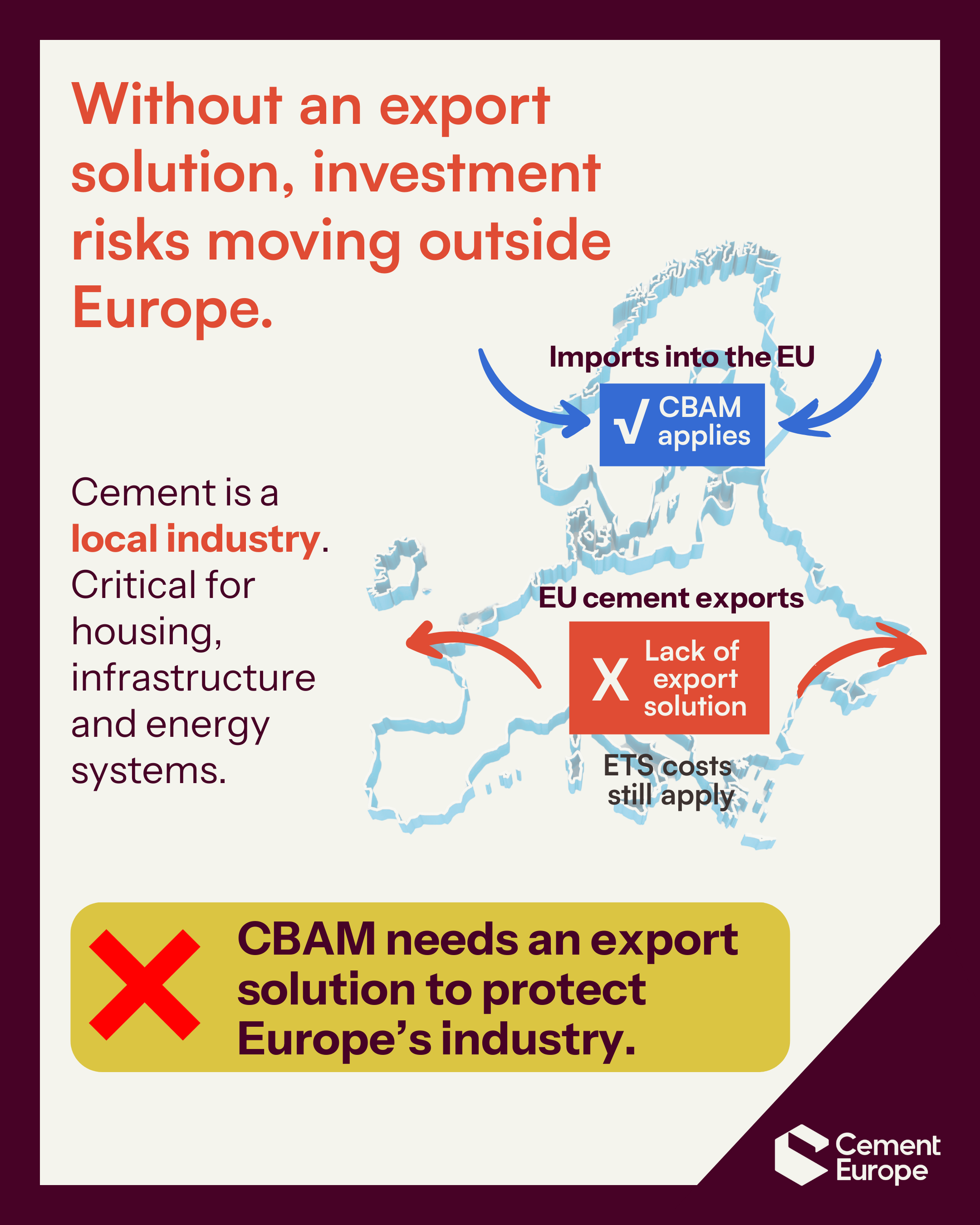
A credible CBAM must also address exports.
Without an appropriate solution, EU producers remain exposed on global markets, carrying carbon, regulatory and high energy costs that third country competitors do not face. This weakens the business case for investing in low-carbon production in Europe and risks shifting production outside the EU.
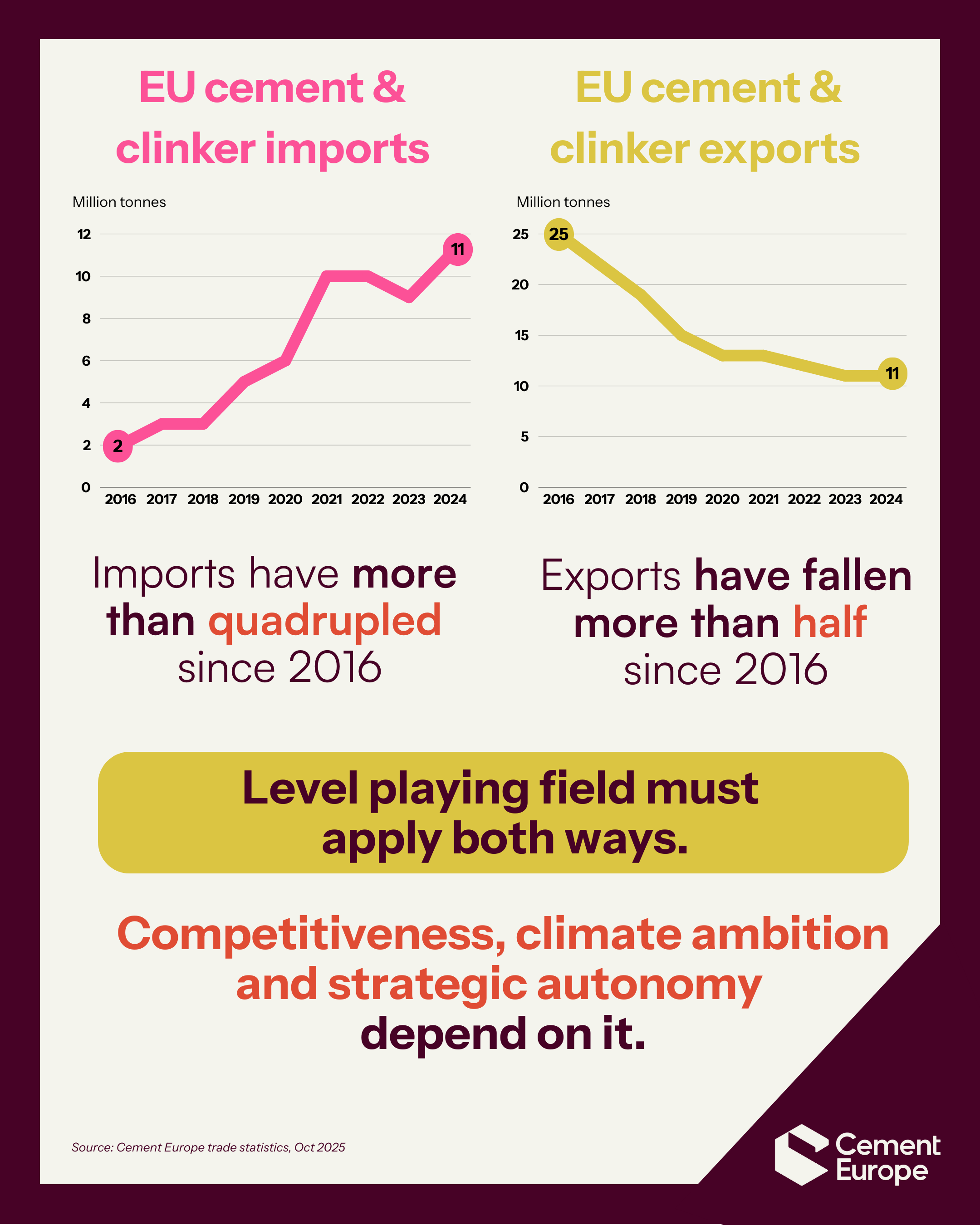
Ensuring that the level playing field applies in both directions is therefore essential to prevent further offshoring of cement production and to maintain Europe’s industrial capacity.
CBAM and ETS: one coherent framework
CBAM does not operate in isolation.
The ETS, as a market-based system, remains the core driver of decarbonisation in the EU. The reform of the ETS, to be proposed in Q3 2026, offers a key opportunity for securing long-term planning for decarbonisation projects that are needed if the EU is to reach net zero by 2050. In this context, an orderly and transparent review process with a focus on the long-term functioning of ETS is critical.
No further delay in the adoption of the ETS benchmarks for the period 2026-2030 with benchmarks that fully comply with the EU ETS Directive and its Annex I is equally important, as regulatory uncertainty around the newly introduced binder benchmark is unhelpful for the industry's long-term business planning.
CBAM and ETS must function together as a coherent framework. A strong and predictable ETS combined with a fully effective CBAM provides the stability required for long-term investment.
Turning implementation into investment confidence
CBAM is no longer a theoretical instrument. It is shaping expectations, influencing capital allocation and sending signals to global markets.
The cement industry alone is expected to pay between EUR 100 billion to EUR 160 billion into the EU ETS over the next ten years. ETS revenues must be channelled back to the ETS-sectors to support their decarbonisation pathways. Allocating these resources to de-risk major transformation projects will help ensure that the industry remains competitive and future-proof.
The success of CBAM will ultimately be measured not only by compliance at the border, but by whether it supports investment in low-carbon production in Europe.
Getting implementation right is therefore not a technical detail. It is central to ensuring that Europe can decarbonise its industry while keeping production, jobs and value chains local.


©2026 Cement Europe. All rights reserved